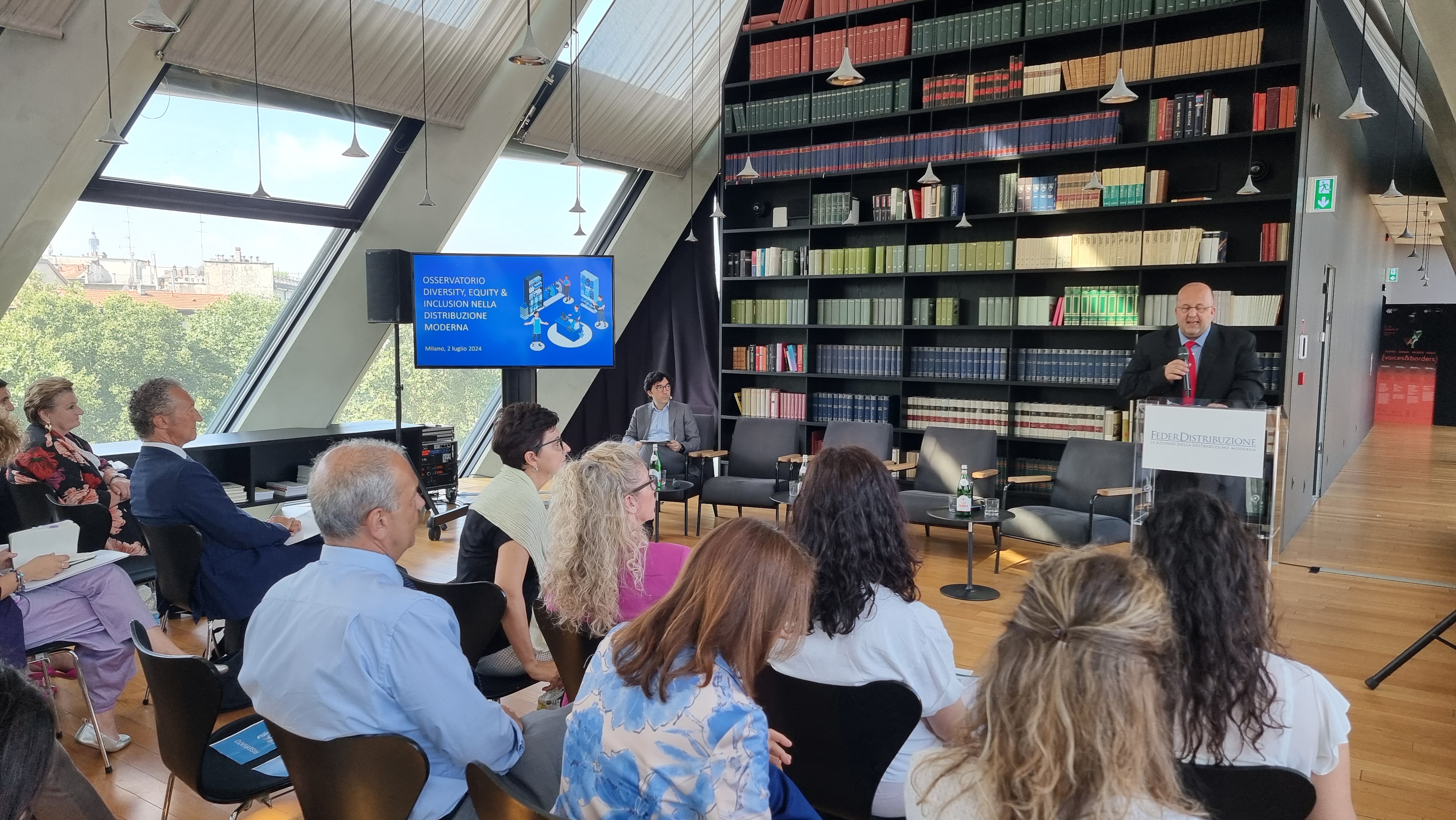
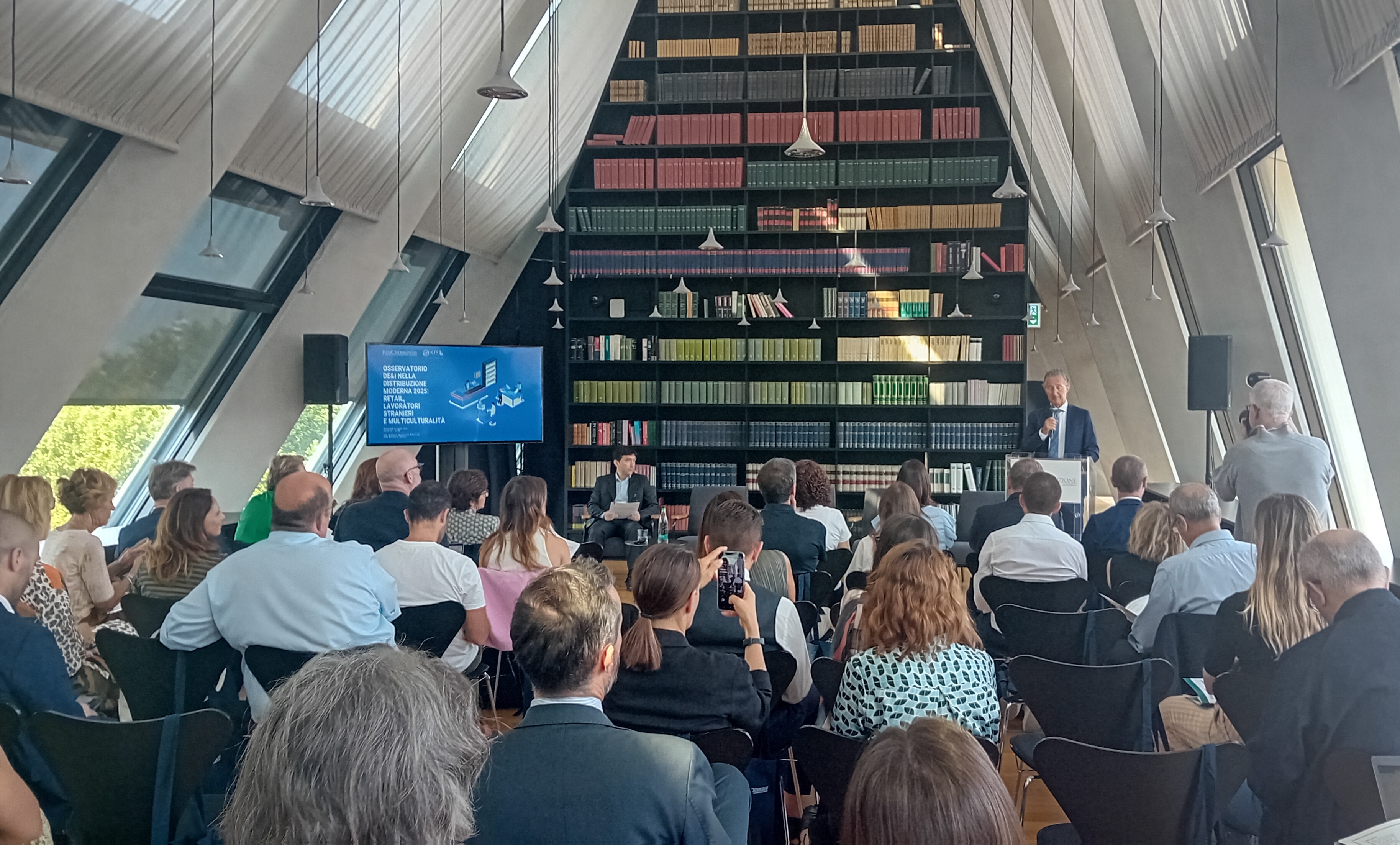
The presentation event of the second Observatory on Diversity, Equity & Inclusion in Modern Distribution, promoted by Federdistribuzione and curated by the ALTIS Graduate School of Sustainable Management of Università Cattolica del Sacro Cuore, was held in Milan. The Observatory monitors the evolution of the commitment of distribution companies on the issues of diversity, equity and inclusion and provides a tool for comparing and sharing best practices among companies and, in the 2025 edition, there is a focus on the issue of the inclusion of foreign workers. The event, dedicated to the theme "retail, foreign workers and multiculturalism", opened with speeches by Carlo Alberto Buttarelli, President of Federdistribuzione, Prof. Matteo Pedrini, Director of ALTIS Università Cattolica, and Anna Maria Gandolfi, Councillor for effective equality of the Lombardy Region.
During the meeting , Chiara Arrighini, researcher at ALTIS Università Cattolica , presented the results of the Observatory, and Giovanni Di Dio, Sviluppo Lavoro Italia S.p.A., with a speech dedicated to the synergies between public and private and the opportunities related to the recruitment of foreign workers. The morning continued with two round tables: the first dedicated to trade union discussion on opportunities, critical issues and proposals to promote the inclusion of foreign workers, with speeches by Marco Beretta, FILCAMS CGIL National Secretary, Diego Lorenzi, FISASCAT CISL National Secretary and Gennaro Strazzullo, UILTuCS National Secretary. The second round table dedicated to the best practices of Modern Distribution companies.
The event, moderated by Nicola Varcasia, journalist of VITA, ended with the intervention of Francesca Tugliani, Head of Active Policies of Federdistribuzione.
The Diversity, Equity & Inclusion in Modern Distribution 2025 Observatory is divided into two sections: the first - in continuity with the previous edition - focuses on the comparative analysis of data relating to DE&I policies and practices widespread within modern retail companies; the second addresses the issue of the inclusion of workers with citizenship other than Italian within work contexts, examining the positive aspects already implemented within organizations, the difficulties that these workers encounter in the path to inclusion and the strategies necessary to overcome these difficulties.
"The results of the second edition of the DE&I Observatory give us back a Modern Distribution sector that has embarked on a path on this front. Structured policies, dedicated budgets and active involvement of people are the sign of an inclusion that is progressively permeating the culture of companies. In a country facing demographic and social cohesion challenges, promoting inclusive work environments is an ethical commitment, but at the same time a lever for competitiveness and innovation," said Matteo Pedrini, Professor of Corporate Strategy at Università Cattolica and Director of ALTIS.
The first part of the study involved 27 large companies in the distribution sector, providing an overview of the evolution of DE&I policies in the period 2024-2025. The data show the increase in the number of companies that have equipped themselves with management committees dedicated to DE&I, from 20% to 37%, and the growth of company policies structured on these issues, from 26.7% to 48.1%. In the two-year period 2024-2025, the allocation of budgets dedicated to DE&I more than doubled, from 33.3% to 70.4% of companies.
At the same time, the adoption of monitoring tools is also growing, from 43.3% to 51.8%, with an increase in periodic control systems, which go from 10.0% to 33.3%. In the field of human resources management, attention to merit is improving: 81.5% (it was 70% in 2024) of companies say they adopt professional advancement paths without distortions. The data on active listening to employees are also positive, rising from 73.3% to 85.2%, and their involvement in decision-making processes, from 63.3% to 92.6%.
Attention to respectful and non-discriminatory communication is also growing: 44.4% of companies provide training on inclusive language, compared to 13.3% in the previous survey. In terms of the inclusion of people with disabilities, both the presence of internal support figures increased, from 33.3% to 44.4%, and the monitoring of the satisfaction of workers with disabilities, from 20% to 29.6%.
The second part of the Federdistribuzione Observatory addresses the issue of the inclusion of workers with citizenship other than Italian, through a qualitative survey based on in-depth interviews involving 12 foreign workers and 6 professionals specialized in HR and DE&I. An inductive methodological approach, which made it possible to collect direct and heterogeneous testimonies, returning a concrete and multifaceted vision of the dynamics of inclusion in the workplace.
What emerges is an overview of the daily actions implemented by modern retail companies: company canteens attentive to different dietary needs, flexibility in the management of schedules and holidays to allow employees to celebrate holidays and anniversaries linked to their cultures of origin, support in complex administrative practices and coaching through tutoring by more experienced colleagues.
Some companies also offer spaces for prayer, meditation or meditation and promote moments of sharing cultural traditions, thus helping to strengthen the sense of belonging. The interviews also reveal the factors of difficulty in the path of inclusion of workers with citizenship other than Italian, on which attention must be paid: from the limited mastery of the Italian language to the cultural differences expressed in behaviors, in the unwritten codes of the world of work and in values, which can generate misunderstandings.
Bureaucratic difficulties, in particular those related to the renewal of residence permits, represent an important factor of uncertainty and stress for foreign workers. Critical issues that can translate into forms of work and relational exclusion, to be countered with support for professional growth, at a social and administrative level.
"The second edition of our Observatory confirms that Modern Distribution companies are strongly oriented towards the enhancement of diversity and the application of the principles of equity and inclusion through concrete business practices. The significant growth in investments, monitoring tools and dedicated initiatives demonstrates not only a constant commitment, but also a growing awareness of the strategic role that DE&I plays in relations with the people who work in our companies, in the sustainable development of companies and in the social progress of our country," said Francesco Quattrone, Director of the Labour and Trade Union Relations Area of Federdistribuzione.