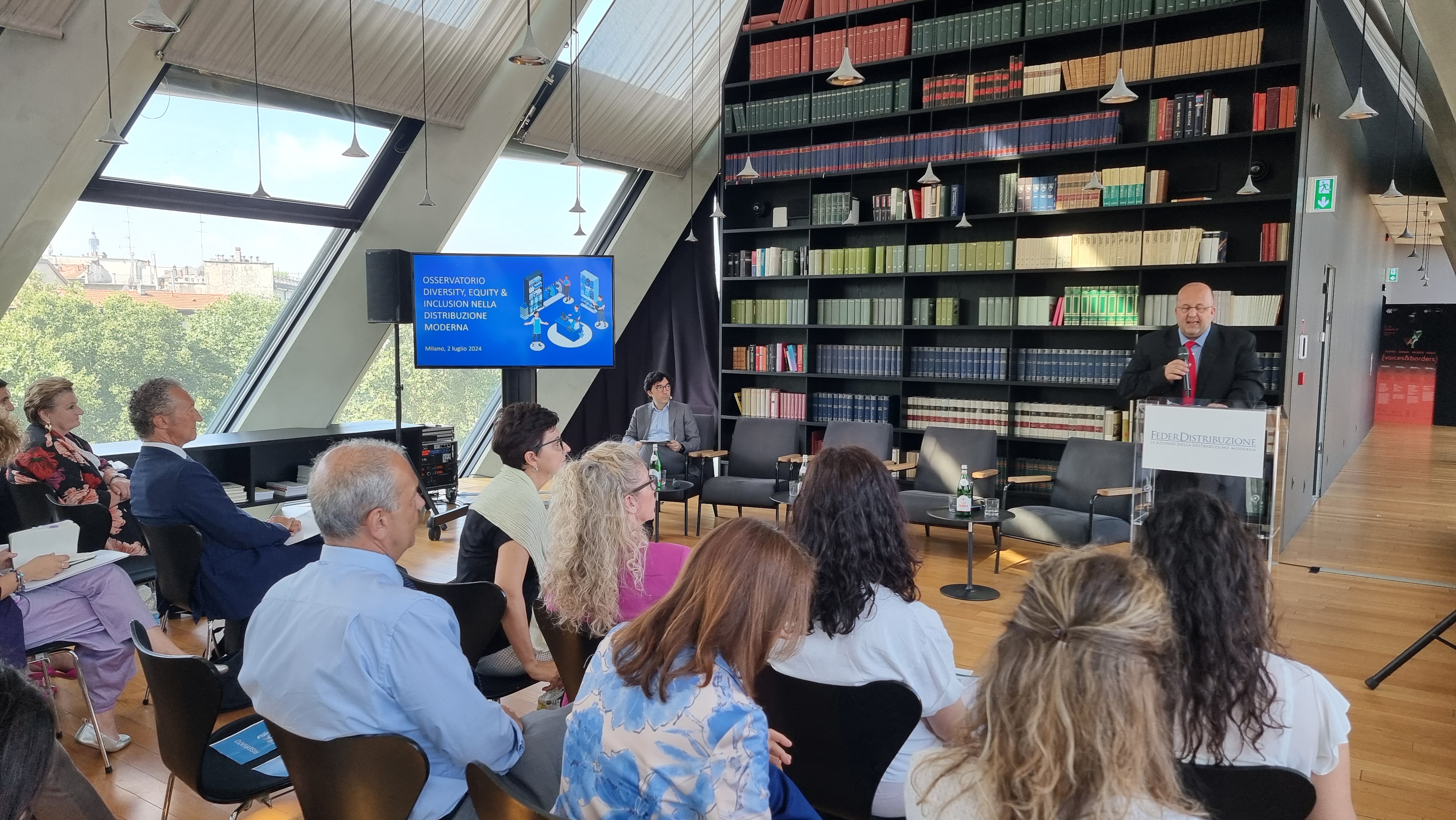
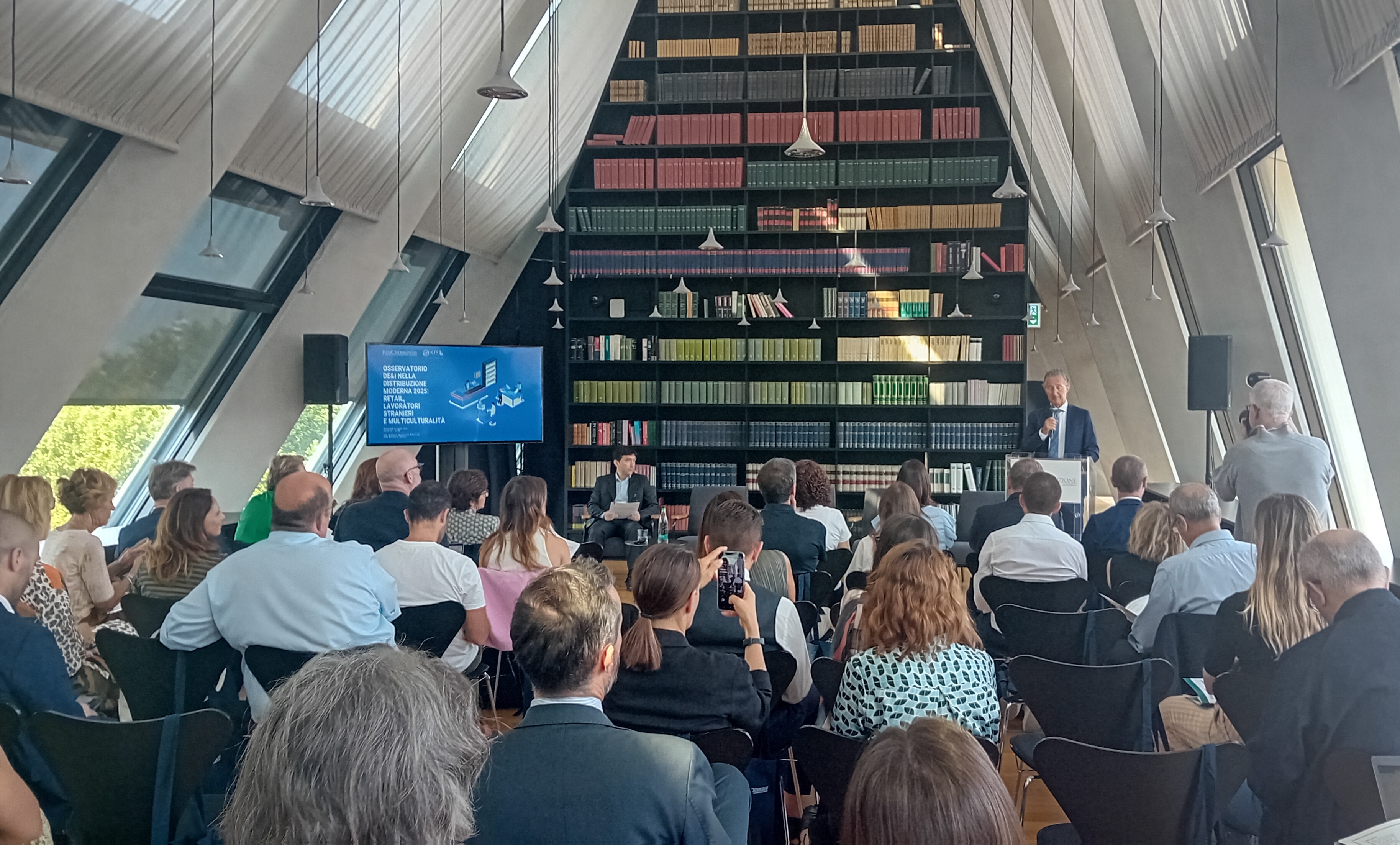
The event "Work inclusion: challenges and opportunities in Modern Organized Distribution" was held today in Milan, during which the research that Federdistribuzione commissioned from ALTIS, the Graduate School of Business and Society of the Catholic University of the Sacred Heart, was presented to analyze the "state of the art" of inclusion in the Modern Distribution sector with the aim of probing the perception by external stakeholders and evaluating initiatives to support the inclusion of retail companies in the world of work.
The event, which was attended by the Minister for Disabilities Dr. Alessandra Locatelli, was opened by the greetings of Prof. Vito Moramarco, Director of ALTIS Università Cattolica, and Alberto Frausin, President of Federdistribuzione, followed by the presentation of the results of the research and a round table dedicated to the Distribution companies that took part. The morning also saw the presentation by Petru Capatina, Founder and CEO of WeGlad, and Riccardo Taverna, President of WeGlad, of the results of the Re-Muoviamole project. A sectoral initiative of inclusion, carried out by Federdistribuzione in collaboration with WeGlad, a start-up with a social vocation, which involved the points of sale of companies as places to raise awareness among workers and customers for the mapping and signaling of architectural barriers in public and private city spaces.
The results of the study
Conducted between March and November 2022, the ALTIS survey involved nine personnel directors from as many companies in the sector, 2,010 employees and 1,679 customers. It emerged that for Modern Distribution companies, the commitment to work inclusion offers several opportunities: the assumption of a role for the benefit of the community and the continuous improvement of the quality of working life and the effectiveness of company organizations, with the consequent customer loyalty which in turn generates positive effects in terms of reputation.
In particular, for people who frequent Modern Distribution stores, the research shows that inclusion does not simply mean including collaborators with different characteristics within the organizations, but instead dedicating attention so that everyone feels an active part of their work context. In fact, for more than 94% of customers, inclusion coincides with initiatives aimed at involving people in the work, regardless of gender and ethnicity. For almost 72% of customers, work inclusion is a very important issue, so much so that it is a factor of loyalty and advocacy: the more a brand teaches is perceived as inclusive, the more the customer will be willing to buy, going to the store, and become an ambassador, recommending the experience for purchases.
From the point of view of internal personnel management, interviews with Human Resources Directors reveal a positive relationship between the promotion of an inclusive corporate climate and the development of organisational citizenship behaviours among employees. Positive discretionary attitudes that go beyond the performance of the tasks provided for in the employment contract and that allow better management of the company as a whole.
Analyzing the point of view of those who work in the sector, almost 63% of employees agree or strongly agree in defining their company as a place where there is an inclusive climate. Even with respect to inclusive leadership, employees in the sector say 75% agree on the possibility of proposing new ideas to their manager. Similar percentages show the willingness of large-scale retail management to confront in case of problems, the openness to discuss the objectives set and any new opportunities to improve processes.
In addition to the benefits, the report also highlights the two main challenges for Modern Distribution companies. One on the business organization front: it is necessary not only to adopt a multiplicity of inclusion initiatives but also to create an organizational structure dedicated to the management and monitoring of these activities to make them increasingly effective. The other challenge concerns communication, both internal and external: a further effort is needed to understand how to enhance the projects launched to promote greater awareness of the company's commitment on the subject, both towards its employees and towards customers, for whom the issue of inclusion is a determining factor in their choices and purchase advice.
"Today, the company is not just a simple economic actor that passively adapts to market changes, but is increasingly configured as a social actor that contributes to collective well-being. Our members are constantly committed to promoting sustained, inclusive and sustainable economic growth, full and productive employment and decent work for all," said Francesco Quattrone, Director of Labor and General Affairs of Federdistribuzione, "the issue of inclusiveness has always been a value for our members who have long understood the importance of people, activating initiatives aimed at promoting equal opportunities".